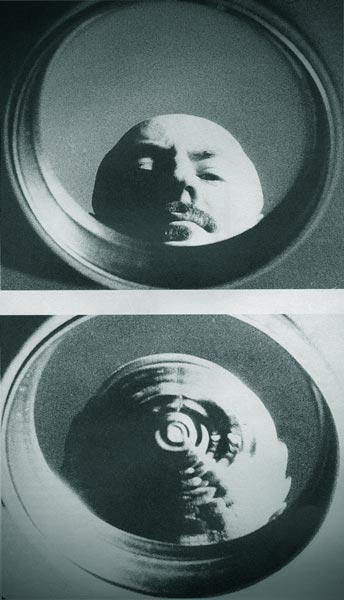
Paolo Monti situates the relationship between form and meaning within a process of phenomenological inquiry, grounded in the observation and measurement of phenomena. While such an approach might appear aligned with scientific methodologies—where reality is understood through constants and variables—it instead serves a different purpose. Monti draws on science not simply to reproduce phenomena, but to position them within an aesthetic framework that moves beyond categories of beauty toward a more abstract, intellectual register, recalling a near-Neoplatonic orientation.
In this context, the work departs from immediate sensory appeal and instead engages with processes analogous to high-temperature fusion, seeking a form of meaning articulated through precise formal conditions. The traditional aesthetic object is displaced; in its place is matter operating within a system of phenomenological and conventional relations. What emerges may be understood as a performance of matter.
Monti’s works are structured by an initial set of conditions, yet it is matter itself that generates the event. The resulting action exists independently of the artist, extending beyond the logic of verification. In this respect, his practice runs counter to the propositions articulated by Allan Kaprow, which defined the temporal and conceptual limits of the happening. Here, the aesthetic event is initiated by the artist but unfolds autonomously.
The materials central to Monti’s current research include dust, magnets, mercury, heat-reactive oxides, acids, and money, understood as a non-solid form. Among these, mercury assumes a particular significance. It operates simultaneously within symbolic and analytical registers: historically associated with myth and transformation, and materially defined by its physical properties. Its only stable form in nature—rhombohedral crystals, as found in cinnabar—contrasts with its more familiar liquid state. Monti engages these properties directly, from the toxicity of its vapours and its reactivity at relatively low temperatures to its reflective, fluid surface. Such characteristics invite a sensory and conceptual engagement that extends beyond vision, implicating touch, sound, and spatial perception.
This approach signals a broader shift toward an understanding of phenomena as autonomous entities. Rather than serving solely as objects of observation, they activate a range of perceptual and cognitive responses, involving intuition, memory, and the integration of the senses. These processes condense perception into systems of recognition that may take on symbolic or even numerical form.
Monti’s installations often take the form of devices designed to register environmental change. His mercury detectors, for example, are calibrated to respond to sound, air displacement, and vibration. The mercury, suspended within iron containers—chosen for their resistance to corrosion—reflects light onto surrounding surfaces, translating external stimuli into subtle visual effects. At the point of activation, the work becomes self-sufficient: the artist’s role is limited to establishing the conditions under which the phenomenon occurs.
A similar logic underpins the “dust detectors,” in which magnets embedded within plaster attract particulate matter over time, gradually revealing otherwise invisible processes. In related works, described as Endo-frottages, internal heating elements activate chemical reactions within the material, producing shifts in colour through temperature-sensitive oxides. In each case, causality is partially concealed, and the work unfolds through duration and accumulation.
At this stage, Monti’s practice suggests a movement beyond iconoclasm toward a more complex relationship between form and formlessness. This is evident in works that propose the visibility of an imprint only through thermal exchange, as well as in ongoing experiments involving money. Drawing on ideas articulated by Georg Simmel in The Philosophy of Money, Monti explores the abstract nature of value through processes of gradual erasure. In these works, chemically treated banknotes deteriorate over time through exposure to light, while their image is simultaneously enlarged through projection, intensifying the conditions of viewing.
Monti’s work remains situated within an experimental phase, characterised by the tension between opposing tendencies: form and process, control and autonomy, subjectivity and objectivity. What emerges, however, is a sustained inquiry into the possibility of aligning artistic practice with the operational logic of phenomena. Rather than resolving this tension, the work maintains it, redefining the artist as the primary catalyst within systems that ultimately transcend individual authorship.
In his philosophy of money, Georg Simmel argued that the possession of money is actually a totally abstract non-possession, closely connected to the phenomenon of voyeurism. Paolo Monti puts this concept into action by creating a sort of “destructive perception,” in which the phenomenon of vision, thanks to an acid that reacts to light, degrades and consumes the banknote over a very precise timeframe. To make the phenomenon even more enjoyable during the voyeuristic act, the banknote, or what gradually remains of it, is projected on a large scale.
It is clear that the artist is still caught between the polar opposites, as is typical of an experimental phase. What is certain is that the foundations for a highly interesting and promising work exist, moving toward a field always coveted by art: science, with its immutables and its “true for all.” But this shift from subjectivity to objectivity represents a genuine crisis for this relationship, since art does not intend to abandon the realm of the individual, or at least not completely. In this case, perhaps we are witnessing the sublimation of objectivity itself, thanks to a sort of transcendence of the individual by matter and phenomenon, which, detaching themselves, become both an individual and an acting subject, with a background noise, namely, the artist’s presence limited to the role of the phenomenon’s primary cause.
“Paolo Monti – Performance of Matter”
by Ada Lombardi – Professor of Art History at the Academy of Fine Arts in Rome
on: Titolo, No. 9, 1992, pp. 2, 26, 27