
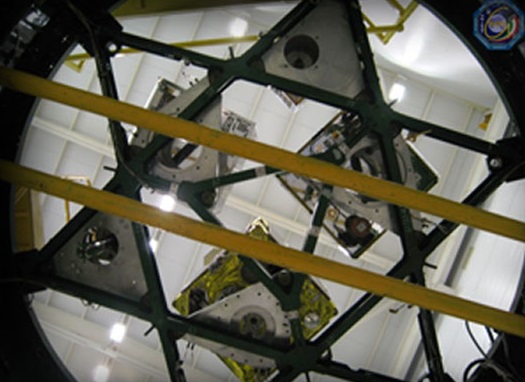
Paolo Monti 37788
Infra–TazebAu s‘pace 2011
LIFT-OFF TAZEBAU S’PACE 2011
Informazione in rivoluzione –
Sindone R.F.I.D. 21’37”
Satellite a propulsione epistemologica
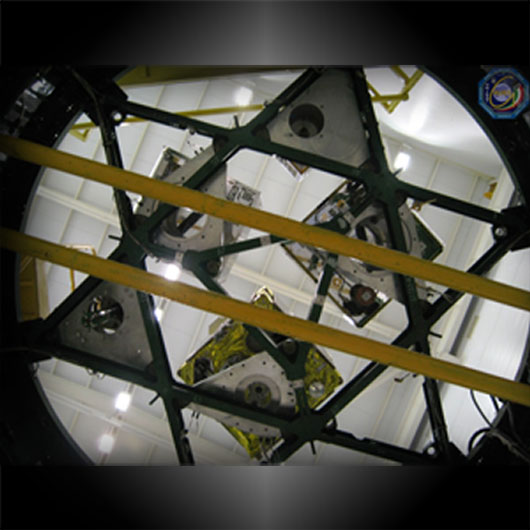
EduSAT – C.G.B.
imbarco : 15 giugno 2011
base di lancio : Yasny – Russia – 17 agosto 2011
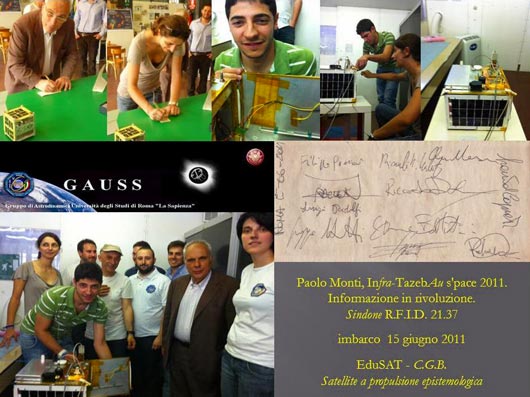
G.A.U.S.S. GRUPPO DI ASTRO DINAMICA
UNIVERSITA’ DEGLI STUDI DI ROMA LA SAPIENZA
TazebAu s’pace C.G.B.
Epistemologically propelled satellite
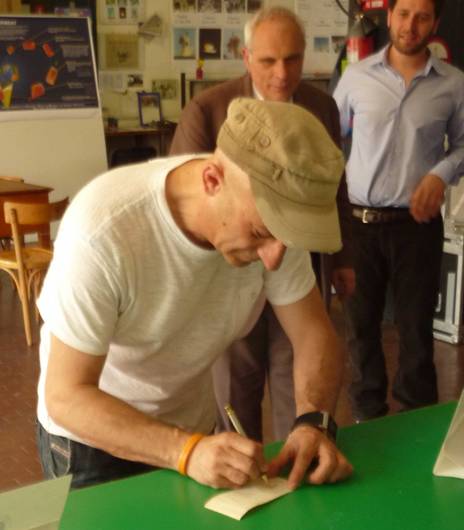
TazebAu in search of traces left by the contexts traversed—absorbed, as if by litmus paper, by a panoptic, dendritic observation of the world…
PRESS RELEASE | August 2011
On August 17, 2011, the Russian-Ukrainian DNEPR launch vehicle placed the EduSAT microsatellite into orbit from the Yasny Space Center, carrying the artwork *Infra-TazebAu s’pace 2011. Information in Revolution. C.G.B. Satellite with Epistemological Propulsion. R.F.I.D. Shroud*. 21’37” by artist Paolo Monti.
The EduSAT program, funded and coordinated by the Italian Space Agency (ASI), aims to promote space-related scientific education among high school students and to support research and specialization activities for university students, doctoral candidates, and young researchers. It consists of a small-scale space mission designed to conduct scientific experiments and test new technologies in orbit, following a low-cost approach.
The microsatellite, built by students from the Astrodynamics Group at Sapienza University of Rome (GAUSS), features a square-based prismatic structure measuring 315 mm x 315 mm x 260 mm and weighs approximately 10 kg; it will be placed into a sun-synchronous polar orbit at an altitude of 700 km.
*TazebAu s’pace*—a meta-environmental work blending science, art, and humanitarian themes in alignment with the EduSAT program—originated from a collaboration between GAUSS (founded by Prof. Filippo Graziani and coordinated by aerospace engineer Chantal Cappelletti, a researcher at the Space Science Center at Morehead State University in Kentucky, USA) and Paolo Monti. For years, Monti has pursued a unique line of inquiry at the intersection of art, science, and architecture, drawing upon Gregory Bateson’s broad systemic perspective to inform the diverse range of expressive languages he employs.
CircoloBateson / Paolo Monti – YOU CAN’T EAT MONEY / Seminar: June 20, 2011
Since 1996, working alongside Prof. Luigi Campanella—president of the Multipolar Museum of Scientific and Technological Information (M.U.S.I.S.)—he has fostered an interdisciplinary dialogue between art and science. This collaboration involves research bodies such as the CNR and ENEA, as well as joint participation in numerous contemporary art exhibitions and editions of the Italian and European Scientific Culture Week.
The collaboration with G.A.U.S.S.—initiated in 2007 with a workshop at the School of Aerospace Engineering (S.I.A.) of Sapienza University of Rome, led by Prof. Filippo Graziani (now a Sapienza Senior Professor and member of the International Academy of Astronautics)—has seen the addition of a new module to the *TazebAu* project. Launched in 2005 along the Venice-Beijing route aboard the “Marco Polo Motoraid,” the project was joined in 2006 by Paolo Nespoli—the man who “made arms sprout.” This new module, *TazebAu s’pace STS 120 Esperia Harmony*, was created with the astronaut’s contribution; at the ESRIN facility in Frascati, he signed the piece and added the code “STS 120,” clearly intending to link it to the Space Shuttle mission in which he participated.
www.cnr.it | news
Conceived as a travel notebook, *TazebAu* consists of bleached dollar bills upon which individuals sign their names, an act that transforms a monetary face value into a relational value. Similarly, this space-bound artwork—dedicated by Monti to Lucio Fontana, founder of the Spatialist Movement and author of the 1946 *Manifesto Blanco*—utilizes a blank dollar bill. Before being loaded onto the EduSAT satellite at the G.A.U.S.S. laboratory on June 15, 2011, the bill was signed by the team led by Prof. Graziani. Once in orbit, the signal transmitted by EduSAT and received by the ground station will allow the exact location of *TazebAu s’pace* to be tracked throughout the mission. The satellite is equipped with a UHF-band transceiver, a VHF-band transceiver, and an S-band transmitter, enabling ground-based operation via the SPIV (San Pietro in Vincoli) ground station, managed by GAUSS.
“Conference themes: the union of Art and Science” – Interview with Dean Filippo Graziani during the TazebAu s’pace 2007 Workshop
http://www.uniroma.tv/video | UNISAT-3 satellite passing over Rome
The primary payload was proposed by high school students involved in the project and built by IMT Srl (Ingegneria Marketing & Tecnologia). It consists of a solar sensor designed to help high school students understand the satellite’s attitude. The satellite also carries other experiments created by GAUSS students in collaboration with other universities, research centers, and industrial partners. To prevent the satellite from becoming space debris—and in compliance with IADC (Inter-Agency Space Debris Coordination Committee) regulations—GAUSS students designed and built a de-orbiting system that will undergo in-flight testing.
www.asi.it EduSAT in orbit | The EduSAT project |
“EduSat,” the satellite made at Sapienza, in orbit at 700 km
The first TazebAu s’pace exhibition was held at the Sapienza Museum of Chemistry, in collaboration with MUSIS, MIUR, and the School of Aerospace Engineering, as part of the 2008 Italian Scientific Culture Week. The video triptych *TazebAu s’pace, 2008. Information in Revolution. C.G.B. Satellite with Epistemological Propulsion* was presented, featuring music by Alvin Curran (*Music is not Music* – 7′ 37”). METATRONZONE | TazebAu 2008 Video Triptych
In November 2011, as part of European Scientific Culture Week, Paolo Monti—in collaboration with GAUSS, MUSIS, and the Circolo Bateson (dedicated to the epistemologist Gregory Bateson)—will organize an exhibition and conference to explore the mission’s themes in depth.
Edusat: an interview with project coordinator Chantal Cappelleti | La Stampa, August 19, 2011
Edusat Project: High schools go into space for the first time
Adnkronos News | Edusat Project – High schools go into space
CATH 2005 Congress – Virtual Money: Data Visualisation and Financial Capitalism